Best Creative Marketing Campaigns of 2017

Capture11
Image Source

Another year is also almost done! With only a few days left to go of 2017, it’s that time of the year when we look back and reflect on the year that was, the highlights of it and what we have learned, as we start thinking about our plans and resolutions for the new year.

As marketers, I thought it is a good time to look back at some of the most impactful and innovative marketing and advertising campaigns of the year, get inspired, think about what made them stand out, and what we can learn from it.

So without further ado, let’s just jump into reviewing some of these most innovative, impactful and memorable marketing campaigns of 2017.

  1. San Francisco Modern Art Museum’s ‘Send Me’ SFMOMA Campaign

As an answer to the question: “How do we get people to see all the art we simply cannot show on the floors of our museum?” The San Francisco Museum of Modern Art launched a service that texts a related art piece in return for an emoji you text them. For the museum, it was a great success, raising brand awareness and creating brand love.

Capture10

  1. Apple: “The Earth” Ad

In recent years, brands seem to have increasingly embraced cause marketing and brand activism, to influence society/environment for better; and Apple is not exception. Apple’s emotive and beautiful “The Earth” ad is almost a direct hit at Donald Trump’s decision to remove the US from the Paris Agreement. The ad uses powerful high quality imagery and is reminiscent of the David Attenborough’s Planet Earth. The ad effectively conveys a very powerful message while also leading with a USP of their product.

  1. IKEA: The “Place” app

One of the marketing highlights of 2017 was IKEA’s lunching its “Place” app that uses augmented reality to show how furniture looks in people’s homes. The app/campaign is a great example of how to create a branded experience that uses trending tech and is genuinely useful to the consumer; as the app helps people make more informed decisions about their purchases.

The company also upgraded its app and added a search engine feature to it after they noticed- through monitoring social media- that consumers were complaining about the lack of a search feature for Place.

  1. Heineken’s ‘Open Your World’ Ad

The real-life social experiment by Heineken delivered what Pepsi failed in reinstating our belief in human kindness and compassion, especially at a time that society is very divided and torn apart over political and societal issues. Though in real life, conflicts might not be as easily solvable as depicted in the ad, but the ad was successful at creating a ray of hope of possibilities. The ad received world-wide acclaim and praise, elevating brand awareness and brand appeal as well as its viewer’s spirits.

  1. Google Pixel 2 Onboarding 

When people connect their new Pixel 2, they receive a welcome email. There is a link that brings you to an amazing user experience filled with videos breaking down the new features. The videos are made to look like the people are interacting with your phone’s interface. Google also used YouTube influencers for the videos to add to the fun.

  1. The Fearless Girl

One successful 2017 example of experiential marketing campaign was the the Fearless Girl statue, by State Street Global Advisors, in a campaign developed by advertising agency McCann New York. The statue was installed on March 7, 2017—the day before International Women’s Day— facing the Wall Street Charging Bull statue. The campaign earned an estimated $7.4 million in advertising dollars, accolades and awards.

  1. Patagonia: Fighting for public lands

Another successful and inspirational example of brand activism for environment protection in 2017 was Patagonia “Fighting for public lands” TV ad. The ad aired only a few days before the Trump administration debated the downgrading of 27 National Monuments, and receive a lot of attention. Their other memorable campaign was save Bears Ears National Monument that encouraged visitors to reach out to the Department of Interior while including an opt-in box to receive emails/texts from Patagonia.

Through these campaigns, Patagonia not only encourage us to protect earth for future generations, but also show business success and corporate responsibility doesn’t have to be mutually exclusive.


Those are my picks for some of most innovative marketing campaigns of 2017 – Of course, this list just includes a few examples and there are many more successful campaigns that I missed to mention here.

Another year with all its sweet and bitter moments passed by and there is always new things to learn from. Happy New Year, you all. Praise be.

Interactive Content Marketing Best Practices

top-four-easy-ways-to-create-interactive-content
Image Source

Content plays an important role in attracting attention to our company and building trust with prospects, but there is a problem; there is so much of it these days. In fact, thanks to internet, we are now living at the era of content overload, as we are barraged everyday with messages in blog and social media posts, videos, presentations, whitepapers, webinars and infographics. One of the ways marketers can use to stand out is interactive content. Interactive content can help your brand cut through all the noise, give your audience something refreshing and intriguing and keep prospects’ attention long enough to deliver a message.

What is Interactive Content?

Generally, “Interactive content” is referred a type of content that requires the participation of the visitor. Instead of just reading and analyzing content, a visitor needs to complete some action. Top 5 types of interactive content include:

  • Assessments
  • Calculators
  • Contests
  • Tests and Quizzes
  • Interactive infographics

Companies has been increasingly using interactive content to differentiate from competition and better engage their audience. A recent study by Content Marketing Institute shows that 81% of content marketers say it grabs more attention than static content. And 79% say interactive content increases retention of brand messages and results in repeat visitors.

The following graph by Demand Metric shows that 3 times as many marketers said interactive content performed “very well” as compared to traditional non-interactive content:

1

Online interactivity requires relatively new technology, but it is becoming increasingly easy to build and integrate into marketing mixes. You don’t need to be a developer to implement interactivity on your company’s website. Sometimes, it’s just as simple as copying and pasting specific lines of code into your browser.

While there are so many examples of interactive content today that no one shares or engage with, there are some great examples that have been very successful and inspirational. To get inspired, let’s take a look at a few best examples of interactive content pieces you can learn from. The examples are picked out by ion interactive agency and HubSpot.

1) National Geographic

Some of the most inspiring forms of interactive content match the topics they address. This example allows readers to follow the ancient cave paintings as if they are touring a prehistoric cave, with color-coded topics to provide insights.

2

2) Orbitz Perfect Match Quizz

Whether or not your travel partner will make or break your trip is one question all backpackers ask themselves before embarking on a new adventure. Orbitz knew what was on their audience’s mind and created an online quiz that addresses this burning question — specifically for business travelers.

3

3) The Wall Street Journal

Delivering a large amount of information is a challenge for content creators. This example from the Wall Street Journal does so using searchable, visual stats. The facts are arranged in a number of ways, including a recorded timeline for readers to hit “play” and simply watch.

4

4) Yesler’s Marketing Automation Playbook

Yesler is a famous B2B marketing agency that provides solutions for the biggest brands. Their Marketing Playbook covers the most important marketing benefits and issues. It’s perfect for people who consider using the company’s services already. Thanks to the playbook’s interactive design, it looks more attractive than any other educational site.5

Here, you will find multiple responsive elements. When you click on the tabs, more information appears. Also, Yesler inserted links to their other pages and products. So the Playbook increased the overall engagement with their site significantly.

6

5) Northstar Travel’s Los Cabos Infographic & Quiz

Travel Weekly‘s NorthStar site also decided to stand out from competition with an ultra interactive site. For doing so, they combined a couple of interactive options: Los Cabos guide and Los Cabos quiz. The guide is very well structured and looks tempting.

7

Northstar’s quiz was a great chance for visitors to check their knowledge. But it also included an opportunity to win a gift card. Offering an award is a great incentive to get even more people to interact with your site.

The company gives their customers a choice: to browse the guide or to take a quiz. Giving choice to users is very important. If you offer only one option, they will either take the single option or leave the page for good.

8

6) Navicure’s Cash Flow Potential Calculator

Navicure is a provider of account solutions that help increase the profitability of the business. The target audience of the company is always looking for some advanced ways to increase their returns. Navicure’s Cash Flow Calculator is a great example of an interactive utility content. It’s a test that helps to determine what kind of cash flow improvement you can expect.

9

The results of the quiz are given right on the website. But if you want a detailed analysis, you can ask for a full report. Again, you need to enter your email address. Engagement level helps Nacivure determine which customers who really interested in their services and which are just passing by.

In the end…

As you see, interactive content can be a great way to make your content stand out from the crowd and to gain both shares and links. The creation of interactive content takes more time and efforts than writing a blog post. You also might need extra help with the implementation of your idea. But if well-executed, the results can worth the effort and money.


Best Practices of Virtual Reality in Marketing

vrr
Image source: Loanpride

Virtual reality and augmented reality technologies has been among one of hottest topics of 2016 and 2017. The research firm, Tractica, predicts that over  200 million virtual reality (VR) headsets will be sold by 2020. Also, according to Forbes, 75% of the world’s most valuable brands have created some kind of virtual or augmented reality experience to engage with consumers.

In 1960s Morton Heilig invented the first VR Head Mounted Display (HDM). The headset provided stereoscopic 3D and wide vision with stereo sound. In the 21st century. The rise of smartphones with high-density displays and 3D graphics capabilities has enabled a generation of lightweight and practical virtual reality devices. Currently some of the most popular VR sets include:

1-Playstation VR (including Playstation VR Bundle)  2-Oculus Rift 3-HTC Vive

Beside the professional VR headsets mentioned above, two most popular smartphone-powered VR headsets in market are 1- Google Cardboard  2-Samsung Gear; Smartphone VR headsets can’t offer  the full VR experience and quality of a professional VR headset but are much more affordable and give customers a taste of what the professional models offer.

Though video game industry has continued to be the main user and drive force behind the development of consumer virtual reality, but VR is now being used in a wide range of industries especially Medical, Education, Tourism and hospitality, Automotive and Fashion and retail.

Through providing immersive, impactful and memorable experiences, moving from storytelling to “storyliving” – a term coined by Google to describe VR-powered experiences and communications- VR presents marketers with a powerful tool to engage their customers.

Following are some examples of smart marketing uses of the VR technology, illustrating a range of ways VR can help brands achieve different marketing objectives:


Merrell – Trailscape

To support the launch of a new hiking boot, the Capra. Merrell created a VR experience called Trailscape that takes you on a dangerous mountain hike. Participants walk along a stage set that is mapped to the virtual experience to create a new level of immersion. The motion capture allowed adventurers to explore the mountainside, with tactile elements such as rope walkways and shaking wooden planks, making this one of the most immersive VR experience to date. Showcased at 2015 Sundance Film Festival.

The New York Times – Displaced

The New York Times has been a pioneer in Virtual Reality storytelling. In November 2015, they distributed over 1 million Google Cardboard viewers/glasses to Sunday home delivery subscribers, and produced a VR film, The Displaced, to be viewed with them. In May 2016, they distributed another 300,000: this time, to its longest tenured digital subscribers, and released another VR video, Seeking Pluto’s Frigid Heart. It provided an exhilarating way for viewers to learn about and explore the planet, almost as if they were there. Virtual reality is providing The New York Timeswith a new way of storytelling (storyliving) that keeps the old genre fresh and exciting, and captures the imagination of younger readers.

Patron – The Art of Patron

A Tequila company might not be an obvious beneficiary of a VR marketing strategy, but Patron used the power of VR to tell a compelling story around the companies product. Using a mix of live action and computer graphics they created a 360 journey following the product lifecycle from agave field to being served at a glamorous party. The entire production took six months and was developed by creative agency Firstborn, post-production agency Legend and sound design agency Antfood.

Marriott – The Teleporter

Imagine being able to transport yourself to a beach paradise whenever you wanted?

Framestore VR Studio and Relevant partnered with Marriott to create a unique teleportation experience for the public. Framestore VR Studio writes that it’s, “A Revolutionary 4D Tourism experience for Marriott Hotels, that teleports you first to a Marriott Hotel and then to the beach in Hawaii.” Inside a telephone booth-like structure, they used Oculus Rifts, heaters, and wind jets to take users on a trip to Hawaii and London. Whilst it’s not quite the same as actually being there, it might help you decide on your future trips.

Immersive VR – Apollo 11 Mission

The Apollo 11 Mission was the iconic mission in 1969 that landed Earth’s first human on the moon. Immersive VR Education decided to educate enthusiasts to re-create this event in virtual reality under the same name. The result is the best history lesson since Crash Course decide to start their amazing YouTube series. The project started on Kickstarter and has now published the final result to its backers.

Disney – Star Wars

Disney released a 360 VR fly through experience of one of the locations in the new upcoming Star Wars movie. In it you feel like you are inside one of the speeders during an epic battle. This content was also released using Facebook’s new 360 videos feature, which although not technically a VR experience allowed them to reach a wider audience.

Paul McCartney – Live Concert

Jaunt produced a 360 Video Recording of Sir Paul McCartney’s performance at Candlestick Park. You can download the app on iOS or Android to experience the event (spot the 360 camera rig in the right corner of the picture).

It was a brief review of different ways brands and marketers can use virtual reality to attract and engage their customers. Through providing highly immersive and engaging experiences, Virtual reality can get us experience a new higher level of storytelling, i.e. “storyliving”. And it has just started.

To find out more about different applications of VR in different industries check out the here.


How to Design an Effective Marketing Technology Stack

mobile-phone-1087845_1920

The “one size fits all” marketing approach is a thing of long past. Today’s marketer needs a stack of tools and technologies to use and make sense of the ever-increasing amount of customer data, to deliver personalized, contextual content to new customers, convert leads and retain customers.

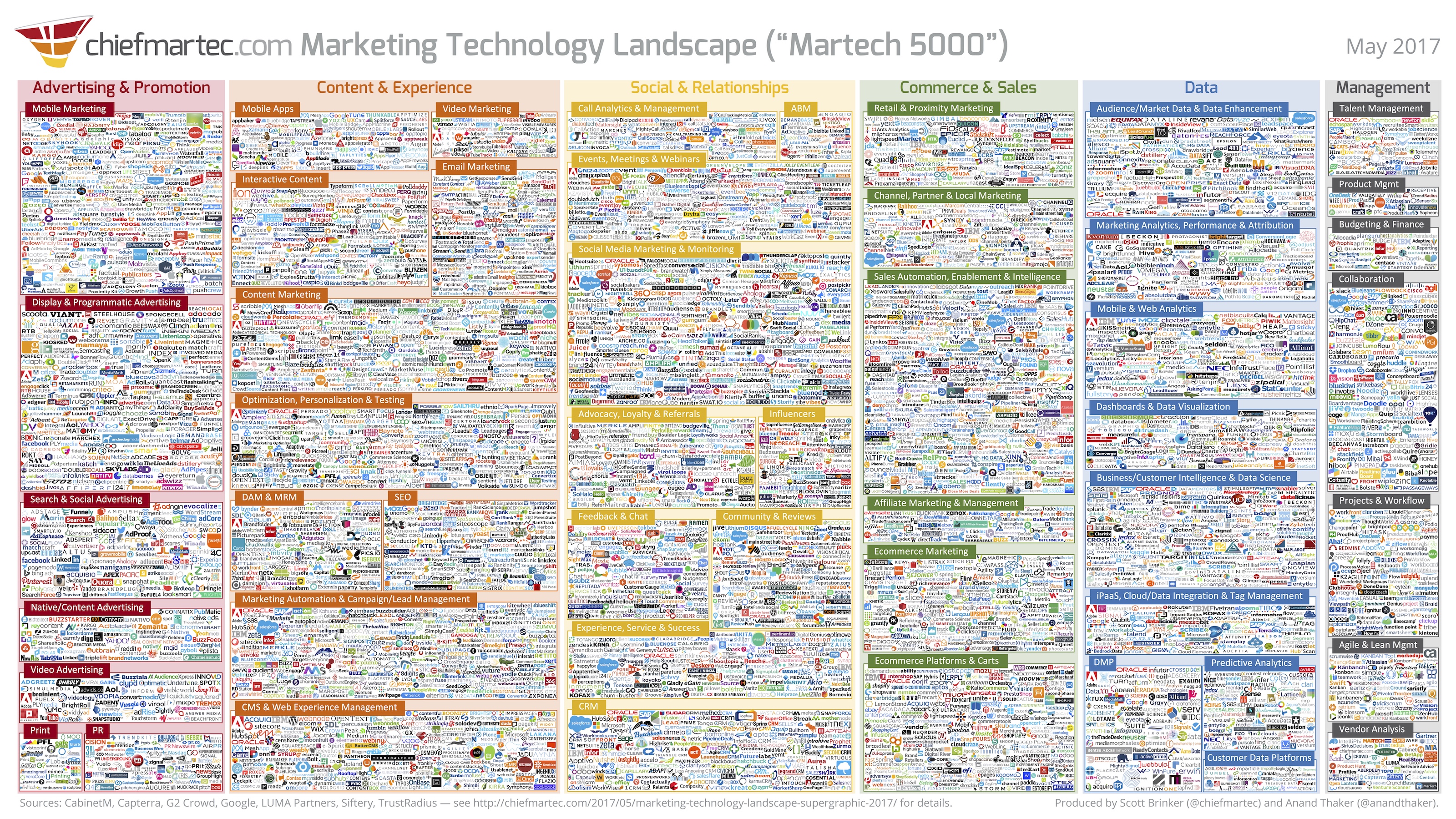
The marketing technology landscape is rapidly evolving, with the number of different software technologies and categories of technologies increasing exponentially.

Data from MarketingLand shows that in 2011, there were about 150 companies offering solutions in areas like marketing automation, email marketing, and customer relationship management- mostly only affordable for larger companies. Today, the marketing technology landscape consist of more than 4000 providers—a number that has almost doubled since one year ago alone. Also, Gartner predicts marketing technology budgets will exceed IT budgets by 2017.

The MarTech Landscape infographic/supergraphic by Scott Brinker (image below) shows all the marketing technologies in the landscape.

marketing tech landscape

Now the question is, with this overwhelming range of software and technology choices, how on earth do you (as a company CEO or marketing manager) choose the right ones for your company?

Marketing Technology Stack: A Framework to Organize MarTech Tools

In sales and marketing, lack of strategy and framework is one of the top reasons marketing technology ends up flopping. A 2017 survey by CMO Council and RedPoint Global revealed only 3% of respondents felt all of their automation, engagement and deployment tools were fully connected, with data, metrics and insights traveling freely between different technologies.

So how can your company avoid such confusion and subsequent budget loss? The answer is probably spending some more time to design a suitable and well-thought-out marketing tech stack framework – aligned with your company’s specific business plan, requirements and goals- before diving to purchase.

In simple words, a marketing technology stack is a set of technology-based tools (SaaS platforms, software, social media tools, etc.) a marketing team can use to function better. All those tools need to be integrated in one system, and work and communicate together. Marketing technology stacks come in all types, shapes and sizes. The most important thing is to choose/design the stack that works for you.

Each business type will use different channels and techniques to acquire customers, and will have different technology needs as a result. So the tools you choose has to fit with the type of your business (e-commerce vs. Media vs. B2B, for example), the size and needs of your business/ your business model, and your future strategy for growth.

Before you start choosing any tools, start by sitting down with your team to have complete clarity on your overall strategy and goals, how to achieve them, and what tools and technology support you need to do it. When assembling a marketing technology stack, it’s important to know which technologies are foundational, and should be put in place first. When designing a MarTech framework , having an updated knowledge about the key components/categories of a tech stack can be very helpful.  Following are some of the key components of any marketing technology stack you need to consider when designing your marketing technology stack- no matter the type of your company:

Key components of marketing technology stack

Content Management System (CMS) – technology that powers a website, blog, or other relevant web properties. The most common example is WordPress, which now powers over 30% of the internet. Content Management Systems make it easier for non-technical team members to log into a website and make quick changes to key marketing materials, without having to deal with any code.

Advertising Technology – this will be a critical component of the customer acquisition efforts for most companies. Most technologies in this area will use a combination of SEM (search engine marketing), display ads, retargeting, and ad tracking or attribution software. The most common technologies in this category will include platforms like Google AdWordsBing AdsAdRoll and facebook Power Editor.

Email – with an average ROI of 40:1, this is one of the most powerful communication channels for any business. The level of complexity will vary from business to business. While some organizations may require a robust solution like Infusionsoft, others may be fine using something like Mailchimp. Sometimes, email is a capability that comes built into a marketing automation or inbound marketing platform

Analytics and Tracking: You need to track your performance, ads, technology, and everything else; to know what’s working–and what isn’t. By far, Google Analytics is the most common tool, already being used by more than 80 percent of smaller businesses.  Adobe Analytics, is another popular option.

Social Media – this includes technology to accelerate audience growth, monitor activity and engagement, automate content distribution and measure channel performance. While third party platforms like buffer and Hoostsuite allow you to accomplish most of this, many companies also leverage native ad platforms on channels like facebook, Twitter and LinkedIn to launch, manage and measure social PPC campaigns.

Customer Relationship Management (CRM) –As your business grows, and you leverage multiple marketing channels, it becomes difficult to accurately track pipeline activity and sales attribution. The CRM will track all customer relationships and can provide insights on how marketing campaigns influence sales pipeline and customer growth. A solid CRM solution like HubSpot or Salesforce will help you track all customer relationships, and provide valuable insights. Other platforms to choose from include SugarCRM, Nimble, and KarmaCRM.

Search Engine Marketing (SEO) – From search engine optimization (SEO) to paid search ads, search engine marketing is one powerful marketing component. The goal is to appear where people are searching for products or services like yours. Search ads let you test and improve copy, forms, and keywords, then track potential customers via Google AdWords and Analytics. Of course, SEO demands regular, original, valuable content. Many companies depend on WordStreamgShiftLabs, or BrightEdge to complement Google’s tools.

Data Management Platform (DMP) – A data management platform is a data warehouse. It’s software that grabs, sorts, and stores information—and then spits it out in a way that’s useful for marketers, publishers, advertisers, and other businesses. Vendors that sell DMP technology to the digital media world currently include Adobe, Krux, Lotame, Aggregate Knowledge, BlueKai, and others.

Marketing Automation – This is what gathers all your efforts together. It’s a suite that usually includes analytics, tracking, online forms, and even email marketing. Marketing automation suites give your visitors customized content, facilitate sales and marketing, and much more. There are oodles to choose from, but I recommend trying HubSpot, Infusionsoft, or Act-On for smaller businesses. Enterprises should check out Silverpop, Marketo, Eloqua, Pardot, and Adobe Campaign.

Conversion Technology – These tools are used to convert traffic into leads and customers. Common options include platforms like unbounce (quickly build high-converting campaign landing pages with zero coding) and Crazy Egg (track on-site behavior to identify conversion leads).

Interactive Content – content marketing is more competitive than ever. Millions of blog posts are published every day, and it’s becoming harder to break through the noise. Interactive content platformsallow companies to create interactive assets – infographicsvideoswhitepapersbrackets – that better engage your audience, and generate higher quality leads.

Tag Management – These days, websites often have several of tags –  a chunk of code (often JavaScript) that performs a task on your site- that need deploying, including tags for analytics, affiliate marketing, advertising, and so on. With a tag manager, you’re able to deploy the same tag across all pages without requiring ongoing development resources, speed up your site performance, and capture the data from the various tags that you’re using.  If you’re a small or medium-size business (SMB), look at Google Tag Manager. If you’re an enterprise, check out Adobe DTM, Tealium, Signal, or Ensighten. (Source: Travis Wright, Inc.com)

Collaboration – these technologies help teams communicate and manage projects more efficiently. Common examples include Slack, Trello, Asana and Jira.

In the End…

Building a marketing technology stack is not a quick or easy process. Before choosing any software and tool, make sure you’re very clear on your business model, business requirement and business growth strategy.  Think holistically as a business – with different roles and functions) and talk with other teams to understand their needs and challenges. Then research thoroughly to choose the primary marketing platform vendor to help you build your marketing tech stack foundation.

To help you visualize what a marketing technology stack might look like in your organization, you can check out the 41 marketing technology stacks from the 2016 Stackies Awards by Scott Brinker. For more information on how to design a simple marketing technology stack framework for your company check out the article here by Ryan Ruud.

Artificial Intelligence in Marketing

artificial-intelligence-503593_1920

By Shooka Faye

Artificial intelligence (AI), usually in the form of advanced sentient robots, has been a very common and recurrent theme in science fiction books and movies for decades. Some of these fictional stories are about the dangers of intelligent machines revolting against human beings in a dystopian future, and some other depict AI positive potential, in service to society.

In the realm of non-fiction, although AI technology isn’t advanced enough yet to produce a sentient robot- let alone a human-like Android or Terminator like the ones in  science fiction stories- it has already become an essential part of the technology industry, helping us human beings every day to solve many challenging problems in computer science and other areas. In fact many believe that we are at the very beginning of the AI revolution as this technology has just started to transform the way we live and work.

AI is a broad term and is applied when a machine mimics “cognitive” functions associated with human minds, such as “learning” and “problem solving”. The scope of AI is disputed and covers a wide range of techniques and technologies, too numerous to be listed here. Frequently, when a technique reaches mainstream use, it is no longer considered artificial intelligence; this phenomenon is described as the AI Effect. But as of 2017, some high-profile examples of AI include autonomous vehicles (such as drones and self-driving cars), medical diagnosis, creating art (such as poetry), proving mathematical theorems, playing games (such as Chess or Go), search engines (such as Google search), online assistants (such as Siri), image recognition in photographs, spam filtering, prediction of judicial decisions, and targeting online advertisements.

The graph below by HubSpot team presents a simplified but inclusive review of the AI landscape today and the AI most well-known tools and products. In the graph, the x-axis represents the level of technical sophistication of the AI tool and the y-axis indicates the mass appeal of the tool.

ai

Artificial Intelligence in Marketing:

In the field of marketing, AI is currently being used by many different brands, especially giant brands like Google, Facebook, Apple, IBM and Microsoft, and in a wide variety of ways and use cases. AI technologies and tools can greatly help marketers to optimize and accelerate their data and processes, and enables them to engage with their customers in an unprecedented customized and personalized way.

AI era has just started and there is a lot to watch coming, but following are some early examples of successful AI- or what is generally recognized as AI- use cases in marketing:

(Please note that the list of AI tools mentioned in this article are just a few examples and the list is far from complete)

Search:

If you are using search engines like Google, you are already using AI each time you click that “search” button. Also, if you are one of the users of voice search/personal assistance technologies like Siri, Alexa, Google Home, you are using AI each time you ask a question. In fact voice search, and Google’s RankBrain (Google’s machine-learning technology for processing and delivering more relevant search result for users) have been two big AI advances that has been greatly changing online searches/search engine optimization.

These technological AI advancements have significant implications for search and content marketing, i.e. the ways marketers should create and optimize their content. For example With the advent and increasing usage of voice platforms/personal assistance technologies like Siri, Alexa, Google Home, the search behavior of users has been changing significantly. In one recent trend we see that long-tail keywords are getting replaced by conversational keywords; as more users type (or talk) what they want to know in the form of questions/queries than broken keywords. For example, instead of typing in “barbers in Toronto,” more and more users can ask (talk or type) “where should I go to cut my hair?” and they expect the intelligent search engine provides them with the best answer. In order to adapt to all the changes, brands need to change their content and keyword strategy accordingly. Topic cluster keyword strategy/model is one of the strategies brands can adopt in response to these changes, as outlined by the following video by HubSpot. to improve with their SEO.

Content Creation:

Even though AI are not able to write an e-book or analytical research post and opinion column yet, some AI tools can be used to generate good-enough human-sounding automatically-generated email content, personalized reports or messages, or curated content for social media, by sing templates to enter relevant data and keywords. AI content creation tools are especially useful for reporting on data-focused events, like quarterly earnings reports, sports matches, and market data. Brands like The Associated Press and Forbes are already using tools like  Wordsmith and Quill to create clickable news content.

ai2

After creating the content, marketers can also use AI tools, like  Hemingway App, or Rocco to edit their content and make their text clearer, and more concise suggesting different word choices. By 2018, Gartner predicts, 20% of all business content will be authored by machines.

Content Curation

AI technology, with the help of its machine-learning algorithms, learns from the user’s data and show each individual user the most relevant content, helping brands to better engage visitors on their site and increase conversions. Brands like Netflix and Amazon are already using AI to curate recommendations to keep customers engaged.

Email Content Curation:

Brands are increasingly using AI tools to customize marketing emails based on customer preferences and behavior to increase the user engagement and conversion.

AI tools like IBM Watson, Dynamic YieldBoomtrain and Optimove, help brands to segment their customer list into different types of prospects and send out customized personalized email newsletters based on their previous interactions with previous content in order to increase click-through rate and conversion.

Social Media Content Curation:

Social Media Platforms like Facebook are already using user data to algorithmically curate a news feed better suited to user preferences and better engagement. Facebook is also using AI to prevent websites from sharing content that provides a bad user experience. AI helps it to identify and recognize patterns in low-quality sites — things like little original content, clickbait headlines, and multiple disruptive ads and try not to show them in its News Feed.

Customer Segmentation, Predictive Customer Service, Sales forecasting

Content Curation is not the only form of AI-powered marketing personalization. Just like the case of curating content based on previous customer data, AI can also help brands predict their customers, segment and offer them different prices and customer service to increase customer satisfaction and sales.  AI Tools like  IBM Watson, Dynamic YieldBoomtrain and Optimove, etc. – with the help of their machine-learning algorithms – can help brands to gain more and more insights and info about consumers by analyzing big data from billions of data points, including On-site interactions, Referral source, Geo-specific events, Psychographic factors, Purchase behaviors, Past communication. These algorithms them help create customer personas and subsequently curate content, messages and recommendations based on that big data.  Also, brands can use AI-powered customer insights to identify their most valuable customers and which customer segments should be included and excluded from campaigns and better match customers to the products they are most likely to use.


Chatbots and PAs:

Chatbots are becoming a popular means of communication between brands and their customers. Many brands have started using messaging apps to communicate with customers instead of (much more costly) phone calls.  Chatbots using machine learning  algorithms with natural language Processing (NLP) capabilities can stand in for customer service agents and provide customers with the information they need more quickly.

Advertising

According to eMarketer, Google controls 40.7% of the U.S. digital ad/PPC market, followed by Facebook with 19.7%. If you’ve purchased keyword ad space using GoogleAdWords, you’ve already used AI through its automated bidding system.

Frank, is another AI-powered PPC tool, which use algorithms to find the best paid channels to deliver ads to your selected target audience, by looking for the most profitable PPC platforms and buying ad placements in a real-time auction.

Lately, the company, Adgorithms, has created an artificial intelligence marketing platform, called Albert, which it claims is able to take care of all advertising campaigns of a large enterprise. Not much human interventions is required as AIbert _as they claim- analyzes, and optimizes paid ad campaigns (including layout, copywriting, targeting, and bids) across platforms from email to search-engines, to social media.

What the Future Will Be Like With Artificial Intelligence?  

Despite all the controversies around the Artificial Intelligence technology and its potential risks and benefits for future of human society, we have already stepped into the AI age and AI-powered technologies and platforms have already started to impact our daily personal and work lives in significant ways. If used properly, it seems AI can help make human lives easier, more efficient (and enjoyable) by doing more repetitive non-creative tasks and freeing up our time. What is clear is that the future of AI-powered society depends on how humans decide to use the technology. As Michael Littman, computer scientist at Brown University say:  

“We need to value each other first and foremost. Make it clear that the machines that we’re talking about are machines to benefit everybody and not just the people that have them”.